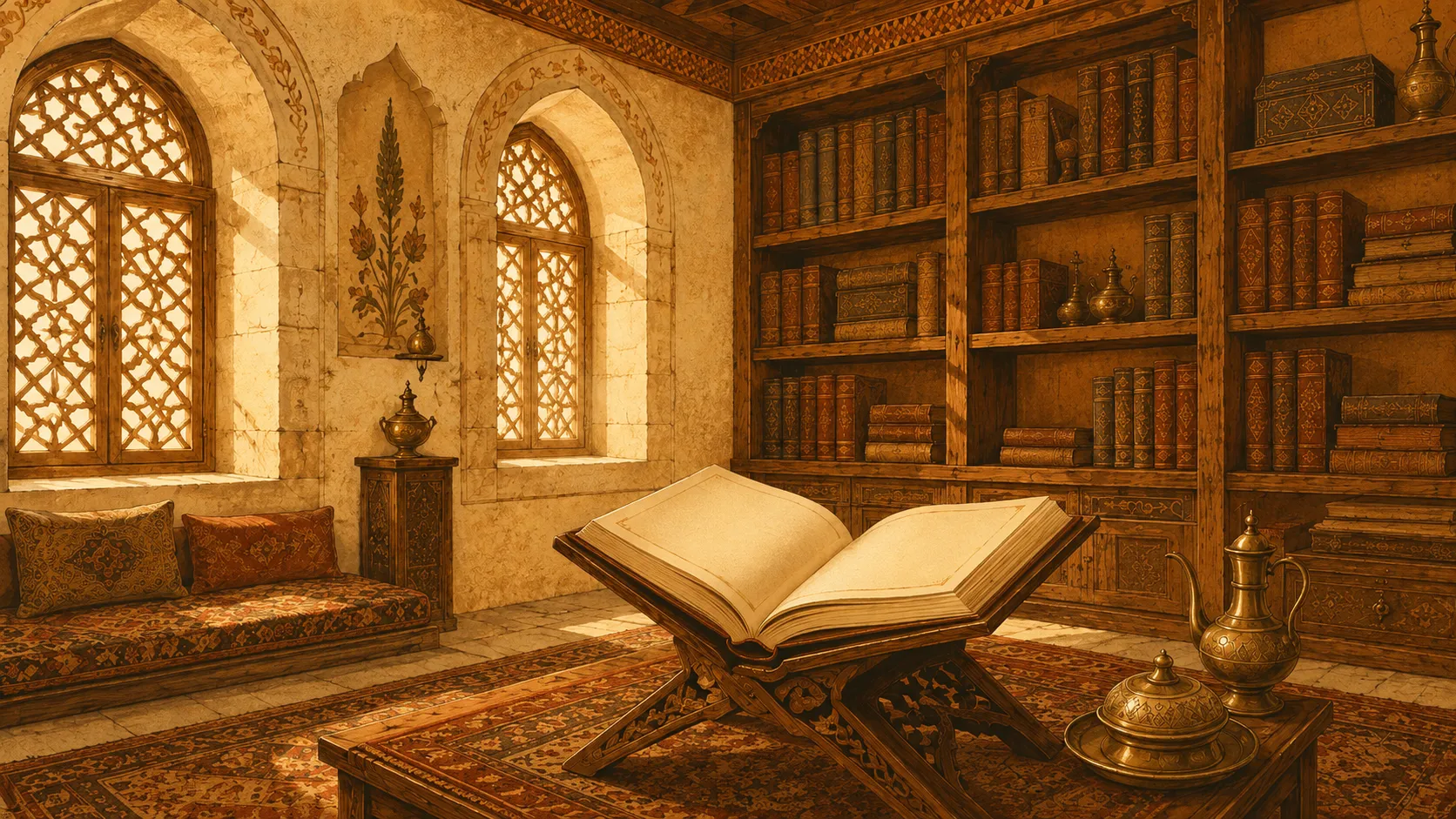
The Hadum Library & Madrasa
The college and famed library beside the Hadum Mosque — for centuries the old city's house of learning, until its manuscripts burned in 1999. The building has risen again; the books are gone for good.
A great bazaar needs more than shops; it needs somewhere to keep what it knows. Beside the Hadum Mosque stood the city’s mind: a religious college and, with it, the Hadum Library — Biblioteka e Hadumit — for four centuries the house of learning at the centre of Gjakova.
A library in the bazaar
Founded as part of Süleyman Hadum Aga’s endowment in 1595 and housed from 1733 in its own building, the library grew into one of the most important collections in the region. By the late twentieth century it held roughly two hundred manuscript codices and some thirteen hundred rare printed books, in Ottoman Turkish, Arabic and Persian — and, tellingly, in Aljamiado: the Albanian language written in Arabic script, a whole literature most visitors never learn existed. Beside them sat the archives of the local Islamic community, reaching back to the seventeenth century.
Two schools, one confusion
It is easy to muddle two institutions here, and many accounts do. The Hadum complex had its own medrese, the college tied to the mosque since the sixteenth century. The grander Great Madrasa the city also remembers was a separate foundation, established in 1748 by its first teacher, Veysel Efendi, with its own dormitories, mosque and ablution fountains. Both belonged to the bazaar’s intellectual life; both were lost in 1999. They are not the same place.
Burned in three days
The library’s end came over a few days in late March 1999, when its contents were set alight and burned on the 27th and 28th. The cruelty of it lies in a detail: much of the building survived — even the façade still stood — while the four centuries of writing inside turned to ash. Worse followed for the medrese, which came through the war only to be destroyed in 2000 by a botched restoration — a monument that outlasted an army and fell to a bad repair.
What a fire cannot give back
The library building has since been raised again, rebuilt in the 2010s with Turkish support, and learning continues here. But a reconstructed room is not a reconstructed collection. The manuscripts — the Aljamiado verses, the copied Qur’ans, a community’s own paper memory — were irreplaceable, and they are simply gone. It may be the quietest and the heaviest loss in the whole çarshia: the bazaar could be rebuilt shop by shop, but a library cannot be rebuilt book by book.
Gallery
Image credits
- The rebuilt Hadum library building.@andreasson.photo
- The old town after the 1999 fire that destroyed the library.Wikimedia CommonsCC BY-SA 3.0
Related places
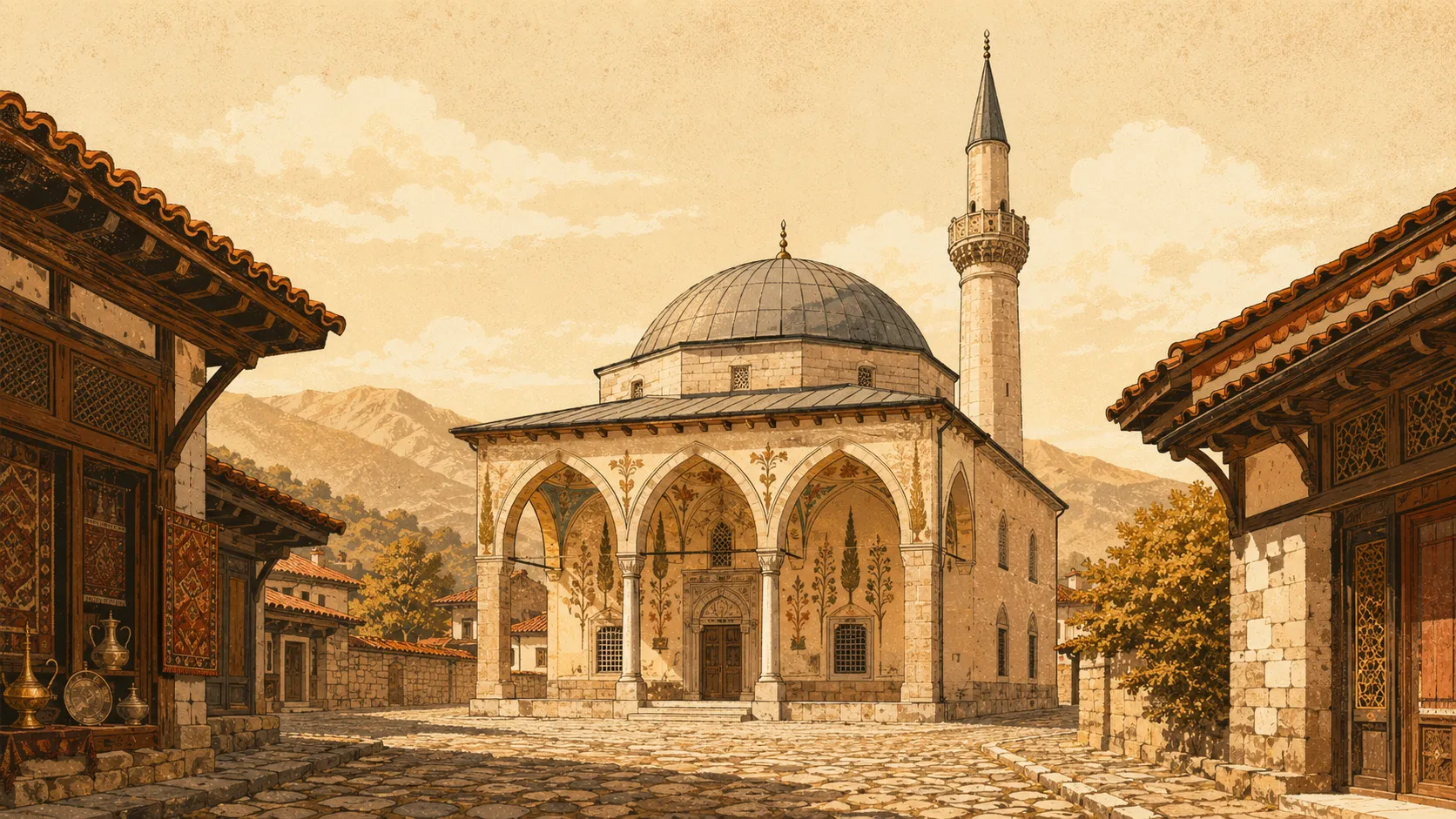
The Hadum Mosque
c. 1594
The late-Ottoman mosque at the head of the bazaar — its interior a painted garden of cypresses and flowers, and the endowment from which the whole old city grew.
Read the guide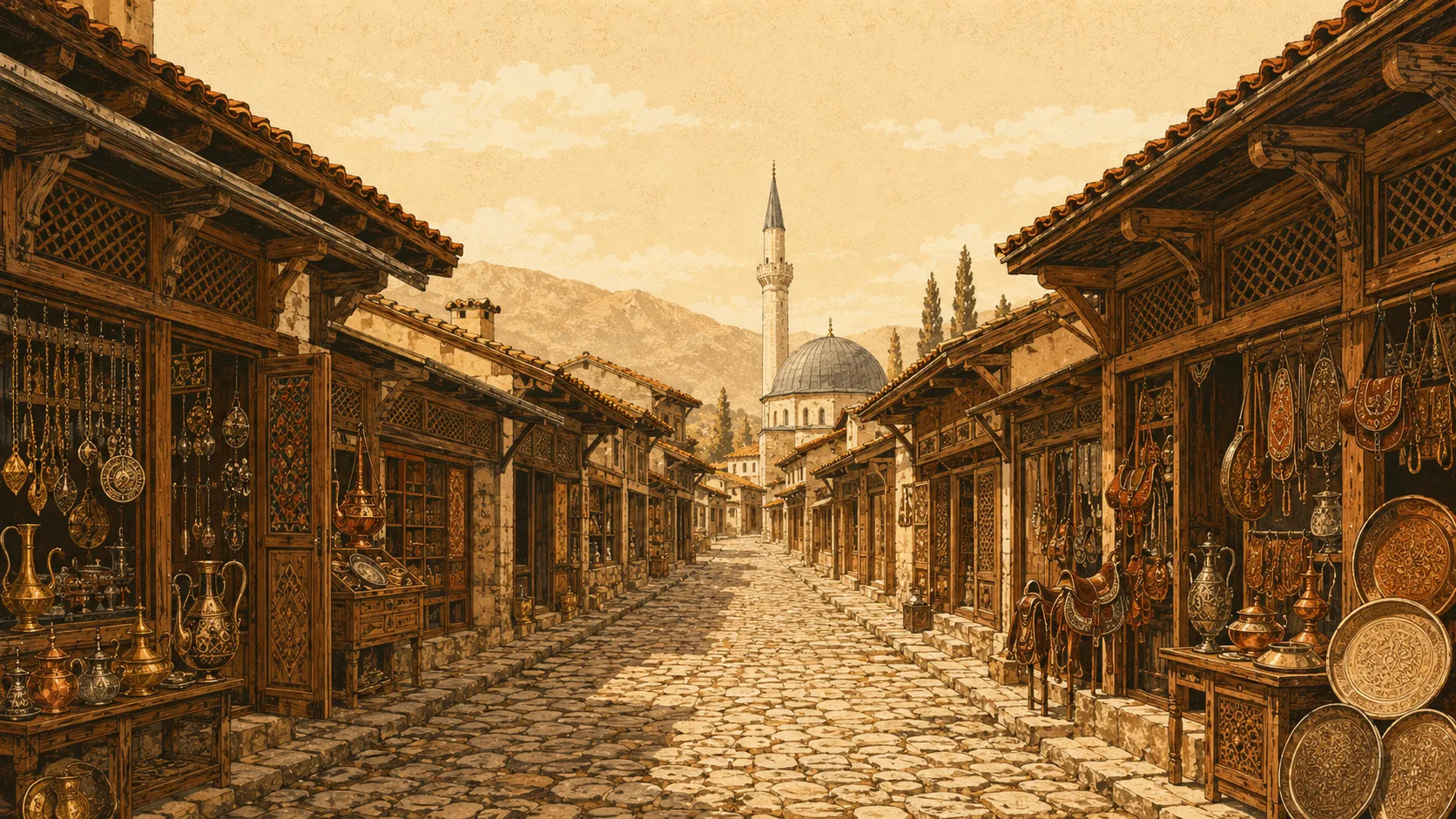
The Grand Bazaar
16th century
The beating heart of old Gjakova — a kilometre of cobbled lanes lined with craftsmen's shops, the oldest and longest bazaar in Kosovo, burned in 1999 and rebuilt shop by shop.
Read the guide