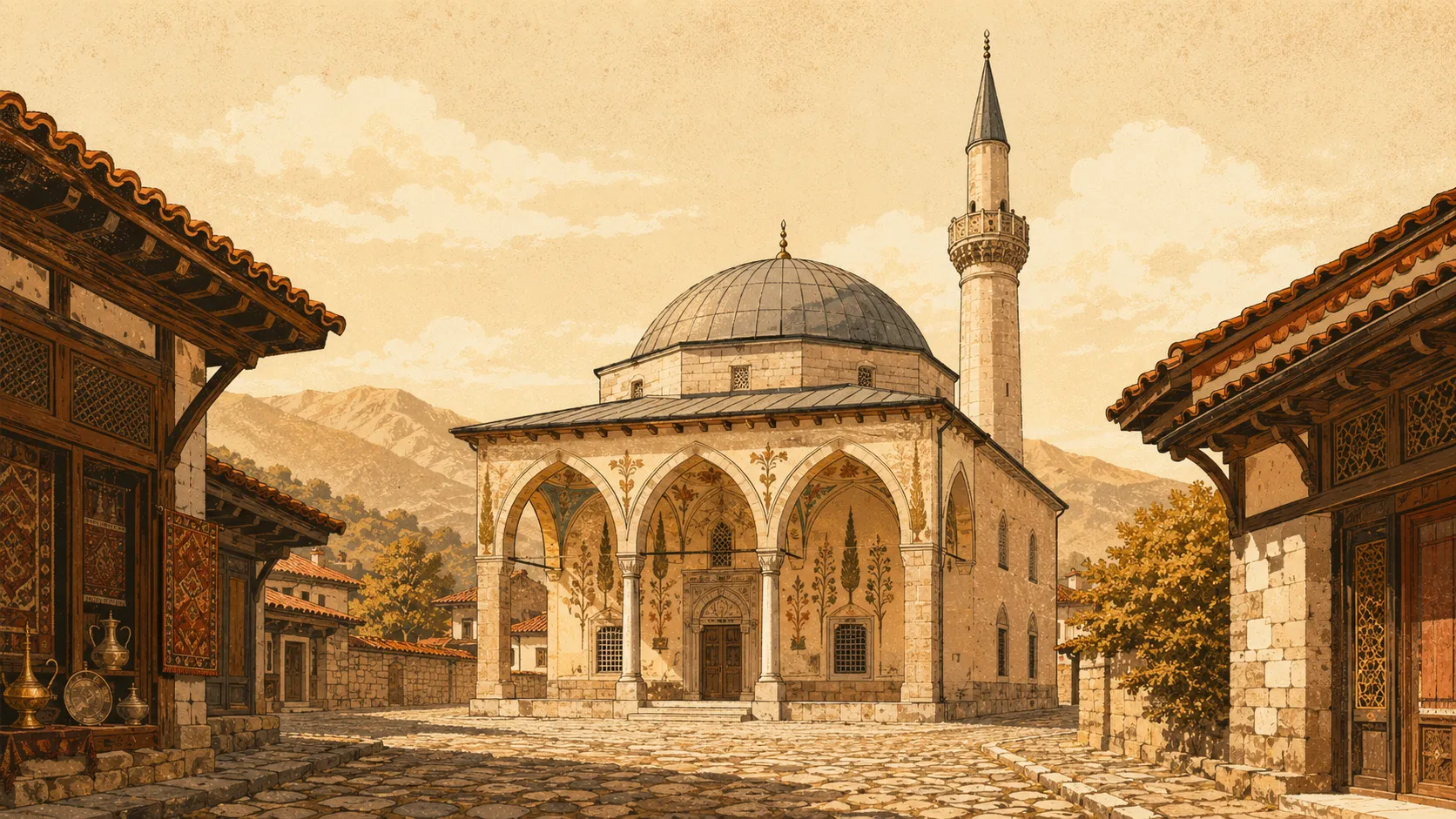
The Hadum Mosque
The late-Ottoman mosque at the head of the bazaar — its interior a painted garden of cypresses and flowers, and the endowment from which the whole old city grew.
Every old city has a first stone. Gjakova’s is the Hadum Mosque — Xhamia e Hadumit — set at the head of the bazaar in 1594–95, the building from which the rest of the town quite literally grew. Its single dome and slim minaret are handsome enough from the lane; the surprise waits inside, where the plaster is painted like a garden.
The eunuch who built a city
The mosque’s founder gave it its name. Hadum is the Albanian form of the Turkish hadım — “eunuch” — and the patron, Süleyman Hadum Aga, was exactly that: a palace official who also bore the epithet Bizebân, “the tongueless one.” Taken as a boy from the nearby village of Guskë under the devşirme levy, schooled in the imperial Enderun and risen high at the court of Sultan Murad III, he endowed his home district with a vakëf — mosque, school, library, bathhouse, inn and shops — that became the seed of the city.
A local tradition explains the city’s name in the same breath: that Süleyman bought the mosque’s plot from a Christian called Jak Vula, who agreed to the sale only on condition that the new town carry his name — Jakova, Gjakova. It is a charming story, and almost certainly a legend; historians treat it as folklore rather than record.
1594, not 1574
You will see the mosque dated to 1574, and you will hear that the great imperial architect Mimar Sinan designed it. Treat both with care. The weight of monument documentation and Turkish scholarship puts the founding at 1594–95; the 1574 date is a minority reading. And Sinan cannot have drawn these walls — he died in 1588, years before they rose — so the attribution survives as flattering tradition, nothing more.
A garden painted on plaster
What makes the Hadum extraordinary is its decoration. Beneath the dome and across the entrance porch the walls are covered in kalem işi — painted ornament in a warm, dominant orange. The art-historical verdict is unguarded:
one of the richest decorated buildings in Kosovo, and indeed the Balkans.
Look for cypress trees, vases and bouquets, clusters of grapes, even slices of watermelon slung in a cloth between two minarets. Strangest and most charming of all, above the entrance the painters set a small portrait of a domed, single-minaret mosque beside a library and a row of shops — the Hadum and its own bazaar, painted onto the building itself. The layer you see is nineteenth-century work, repainted by local hands in the 1930s; older paint still lies beneath it.
The night of 24 March 1999
On the night of 24 March 1999, as the war reached Gjakova, Serbian forces set fires through the complex. The minaret was shot away down to its balcony and the wooden porch burned, taking some of the painting with it. Recovery was slow and international: a Saudi committee began the work in 2000, then Cultural Heritage without Borders carried out the main restoration in 2003–05, with the Packard Humanities Institute and UNESCO helping to bring back the painted decoration. In 2016 the mosque was declared a monument of national importance.
What to look for
Step in quietly — it is a working mosque. Let your eyes adjust, then read the walls the way you would read a book of flowers: the cypresses climbing into the squinches, the painted curtains, the little city set over the door. It is the oldest thing in Gjakova, and the most surprisingly alive.
Gallery
Image credits
- The Hadum Mosque at dusk.@andreasson.photo
- The painted interior and carved minber.@andreasson.photo
- The painted porch and courtyard.@andreasson.photo
Related places
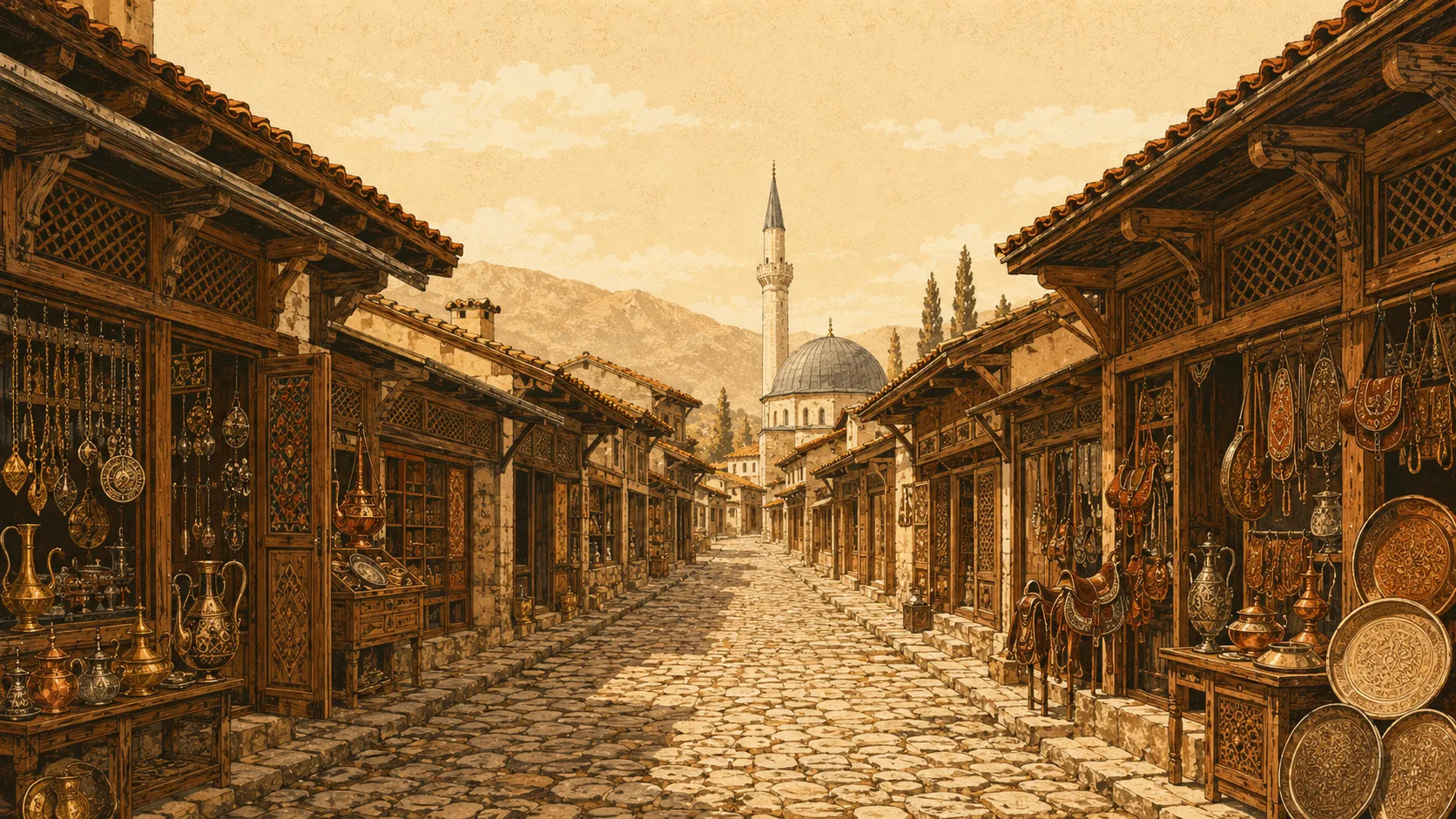
The Grand Bazaar
16th century
The beating heart of old Gjakova — a kilometre of cobbled lanes lined with craftsmen's shops, the oldest and longest bazaar in Kosovo, burned in 1999 and rebuilt shop by shop.
Read the guide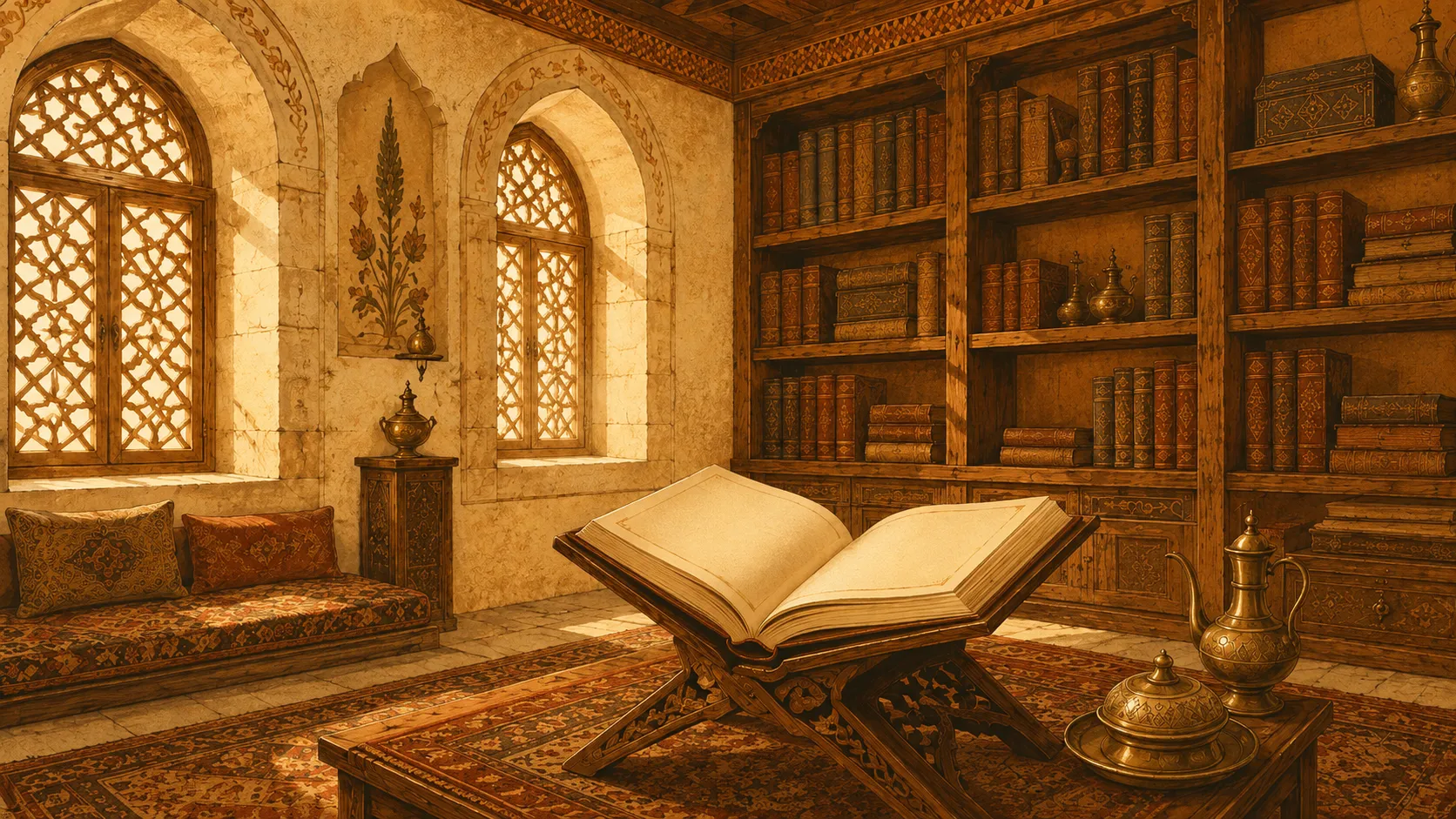
The Hadum Library & Madrasa
founded 1595
The college and famed library beside the Hadum Mosque — for centuries the old city's house of learning, until its manuscripts burned in 1999. The building has risen again; the books are gone for good.
Read the guide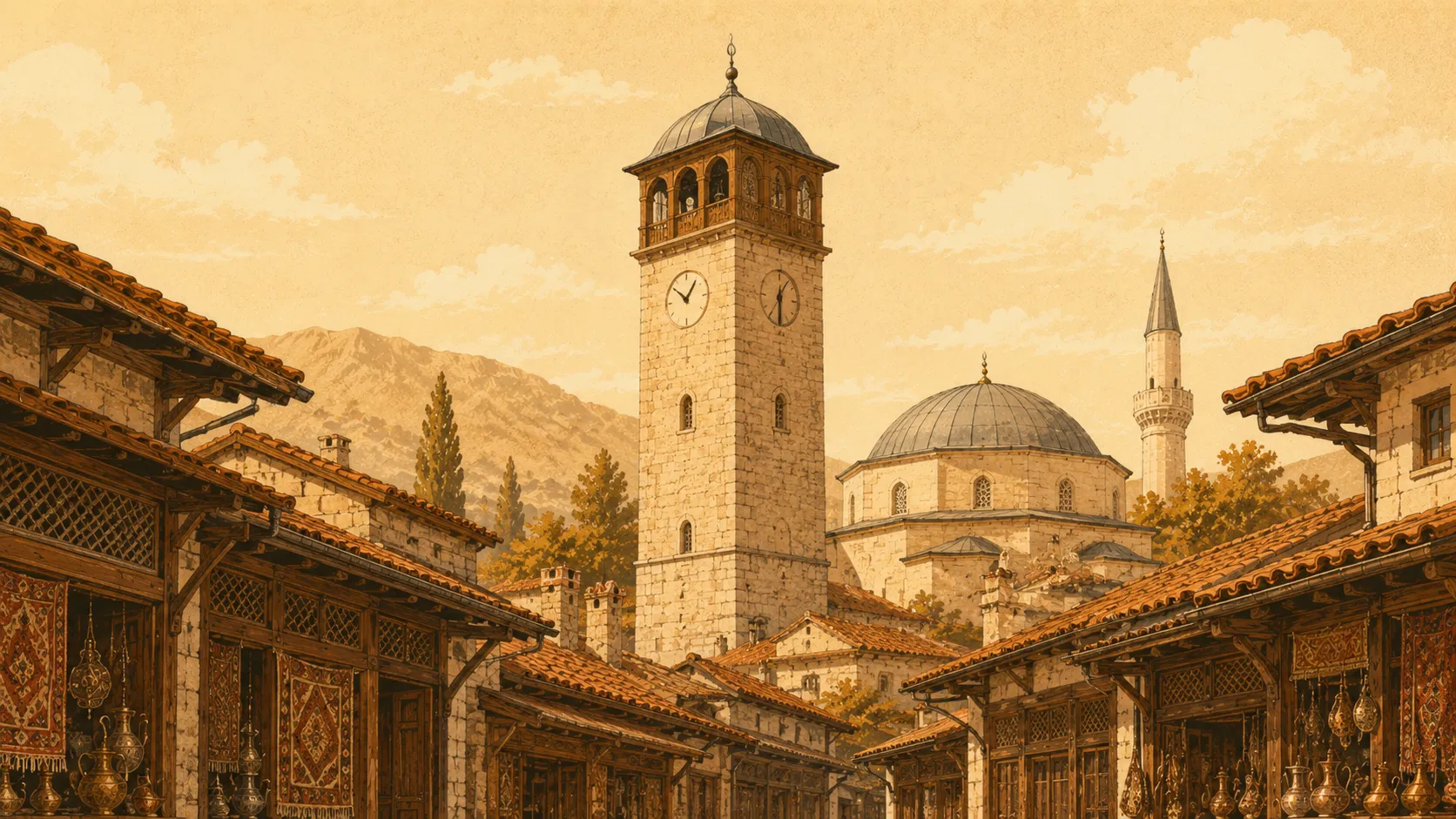
The Clock Tower
c. 1597
The Ottoman clock tower beside the bazaar — first raised in 1597, robbed of its bell by Montenegrin troops in 1912, lost again in the 1999 war, and rebuilt from old photographs.
Read the guide