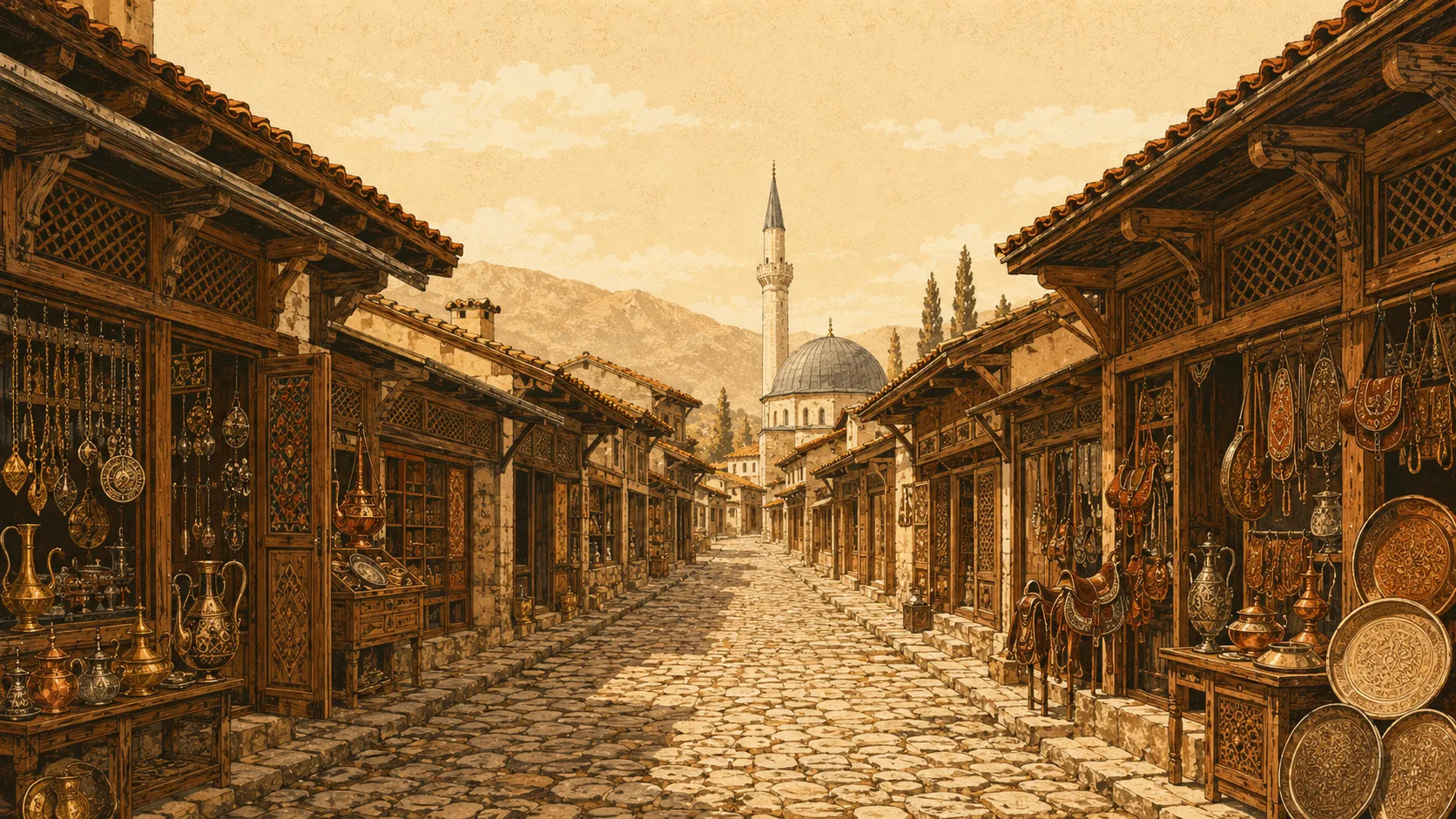
The Grand Bazaar
The beating heart of old Gjakova — a kilometre of cobbled lanes lined with craftsmen's shops, the oldest and longest bazaar in Kosovo, burned in 1999 and rebuilt shop by shop.
Gjakova did not grow around a bazaar so much as grow out of one. The Grand Bazaar — Çarshia e Madhe — is the city’s oldest institution and still its loudest: a kilometre of cobbled lanes where the day is measured in the ring of a coppersmith’s hammer, the resin smell of cut timber, and the slow patter of bargaining. To walk its length is to walk the floor plan of the old town itself.
A market before a town
A market stood here before the town did. Gjakova first appears in an Ottoman tax register — a defter — of 1485, as a village of some fifty-odd households with a marketplace. The bazaar as we know it took shape a century later, when the settlement was raised to the rank of kasaba, a market town, in 1594–95. In those years the court official Süleyman Hadum Aga endowed a vakëf — a charitable foundation — that planted a mosque, a school, a library, a bathhouse, an inn and a row of shops on the open plain. The shops multiplied; the town followed them.
Three hundred shops like nightingale-nests
When the Ottoman traveller Evliya Çelebi passed through in 1662, he found a place already thriving:
A flourishing and attractive town consisting of 2,000 houses, all built of stone with roofs and gardens … two richly adorned congregational mosques, several prayer-houses, some khans with leaden roofs, a delightful bathhouse, and about 300 shops like nightingale-nests.
— Evliya Çelebi, Seyahatnâme, 1662
That last image is his — shops set close and busy as nightingale-nests — and it has stuck to the place ever since. Among them, he wrote, were practised “a thousand kinds of craft.”
A city of guilds
The bazaar’s real architecture was social: the esnaf, the craft guilds. Gjakova’s gunsmiths were known across the region for ornamented firearms — the so-called Gjakova pistols — and in the eighteenth century a master named Tush ran a workshop renowned enough to train a school of imitators. Around him worked filigree silversmiths, saddlers and other leatherworkers, woodcarvers who turned cradles, and bookbinders who copied manuscripts. Most powerful of all were the tailors, whose guild alone is said to have held some two hundred shops. Their goods moved along the caravan road between Shkodër and Istanbul, and the city’s name travelled with them.
Burned, and built again
That long continuity was nearly ended in a single week. In 1999, during the war, Serbian forces set the çarshia alight; roughly four hundred and thirty of its buildings burned, along with the Hadum Mosque’s portico and the old library. What you walk through today is largely a reconstruction — rebuilt through the 2000s on the original street plan, shop by shop, by returning residents and heritage bodies such as Cultural Heritage without Borders. Conservationists are honest that the new timber and stone can read as new: the map was saved more faithfully than the texture. Even so, it was a deliberate act of remembering.
Walking it today
Go slowly, and go early or late. Notice the low timber shopfronts and their worn stone thresholds, the lanes that still sort themselves loosely by trade, and the way the arcade narrows the sky to a bright strip over the cobbles. It is held to be the oldest and longest bazaar in Kosovo — and, more to the point, the one still doing the thing it was built for.
Gallery
Image credits
- The bazaar street at dusk.@andreasson.photo
- A quiet hour in the bazaar.@andreasson.photo
- A woman of Gjakova in traditional dress and filigree, 1913 — the bazaar craftsmen's work, worn.Wikimedia CommonsPublic domain
- The bazaar in ruins soon after the 1999 fire.Wikimedia CommonsCC BY-SA 3.0
Related places
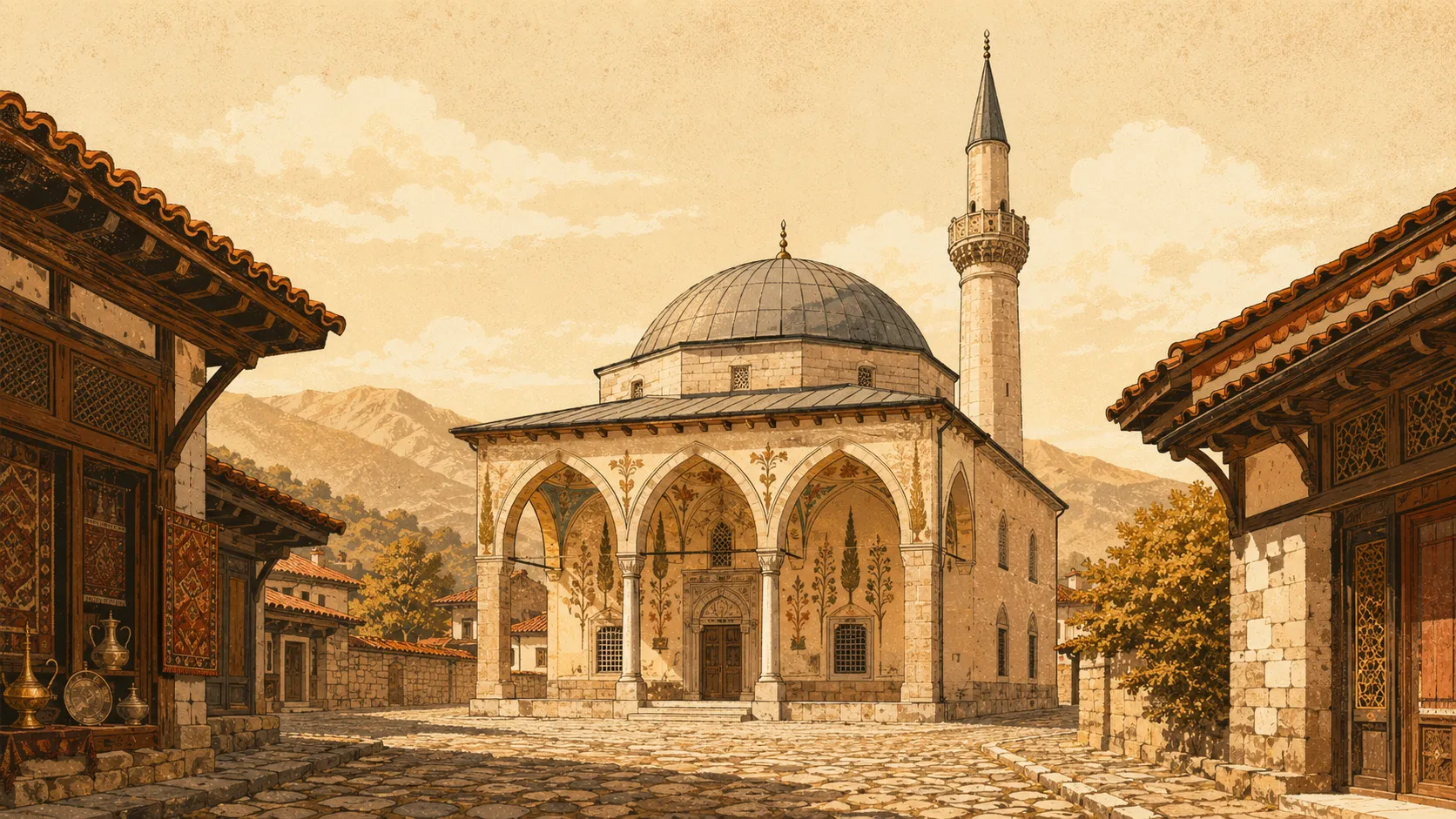
The Hadum Mosque
c. 1594
The late-Ottoman mosque at the head of the bazaar — its interior a painted garden of cypresses and flowers, and the endowment from which the whole old city grew.
Read the guide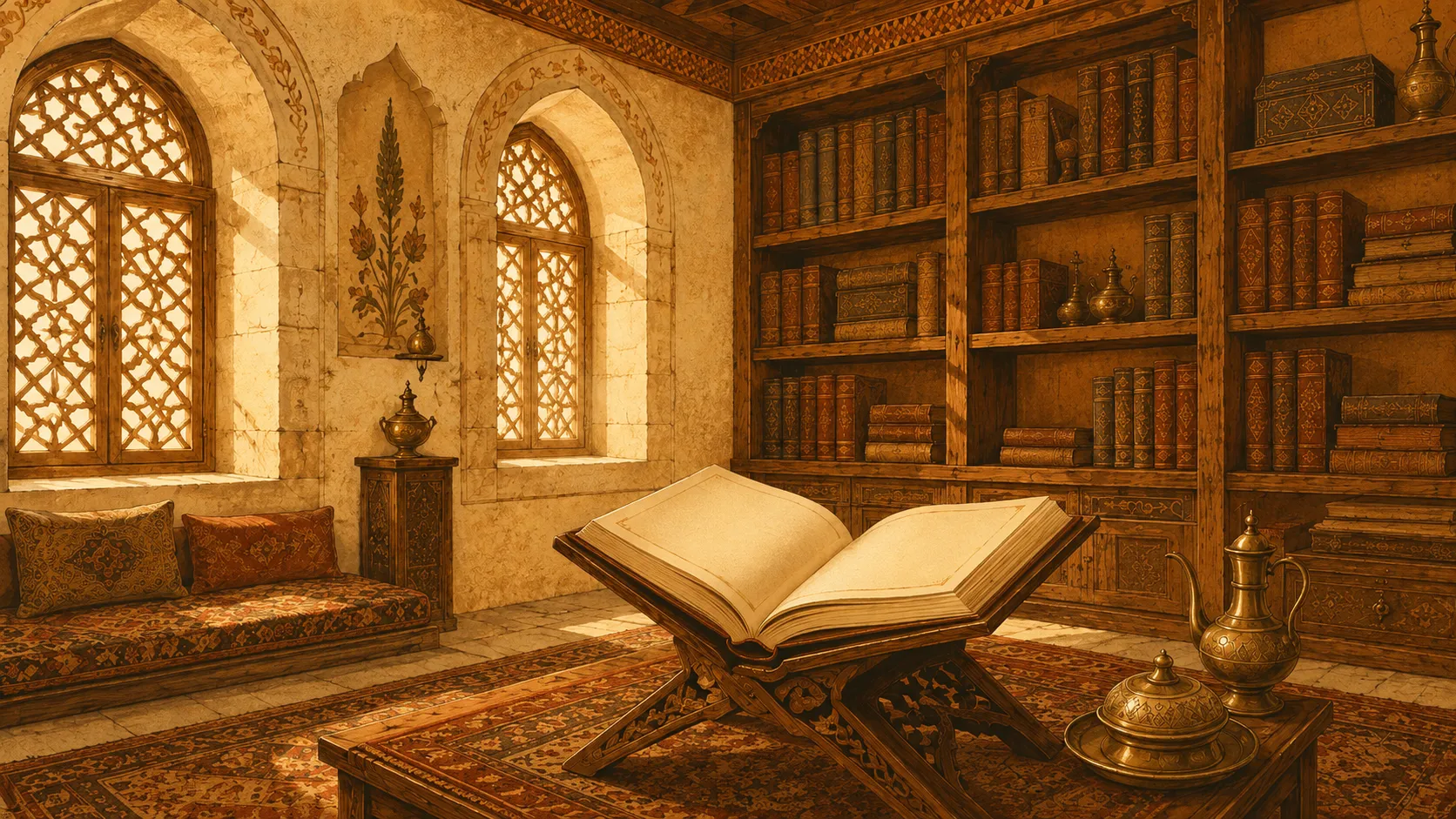
The Hadum Library & Madrasa
founded 1595
The college and famed library beside the Hadum Mosque — for centuries the old city's house of learning, until its manuscripts burned in 1999. The building has risen again; the books are gone for good.
Read the guide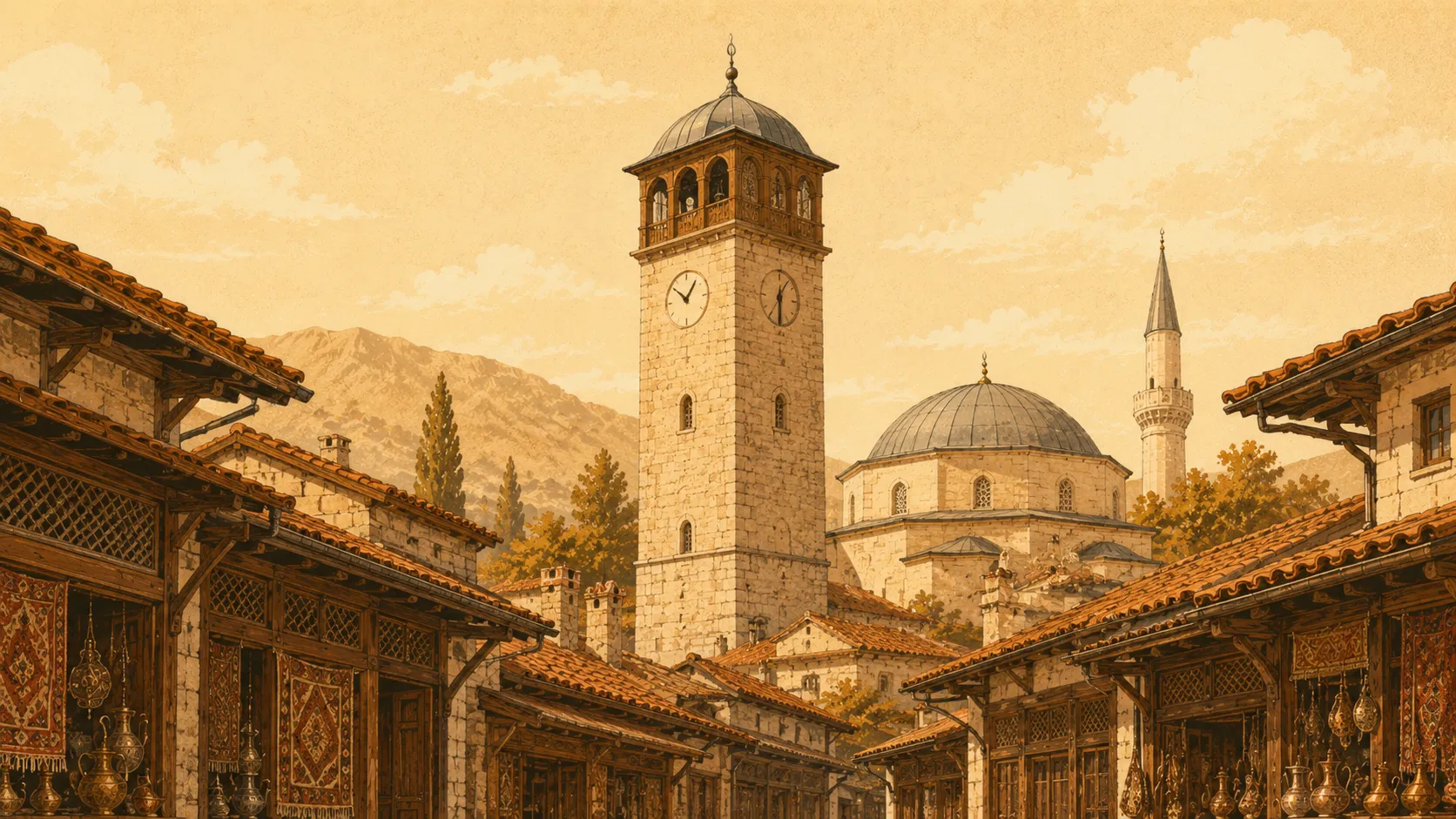
The Clock Tower
c. 1597
The Ottoman clock tower beside the bazaar — first raised in 1597, robbed of its bell by Montenegrin troops in 1912, lost again in the 1999 war, and rebuilt from old photographs.
Read the guide